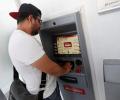
In a big relief to people and small businesses, the Reserve Bank of India on Monday announced lifting of restrictions on daily withdrawal of money from ATMs and from current accounts but the weekly limit of Rs 24,000 on savings bank accounts will continue.

In the fourth of a six-part series, Ajay Modi visits Moradabad, to see how the brass city is coping with the after-effects of demonetisation.

Financial Intelligence Unit data show many of these societies have become the biggest draw for laundering money. Subhomoy Bhattacharjee reports.

Demonetisation of the high value currency notes of Rs 500 and Rs 1,000 did not have any discernible impact on currency in circulation (CIC) in the country, which has soared by almost 83 per cent since its announcement on November 8, 2016. The Supreme Court on Monday upheld the decision of the government on demonetisation. On November 8, 2016 Prime Minister Narendra Modi had announced demonetisation of old Rs 1,000 and Rs 500 banknotes and one of the key objectives of the unprecedented decision was to promote digital payments and curb black money flows.

The premises are alleged to be of the domestic help of Jharkhand Rural Development Minister Alamgir Alam's personal secretary Sanjiv Lal.

'They are not tom-tomming what a great thing the Supreme Court decision is.' 'If they say it was a great thing, the public will react because people suffered and are still suffering.'

Sources said the government was keen to tax all unaccounted money deposited in bank accounts after it allowed the banned currency to be deposited in bank accounts during a 50-day window from November 10 to December 30.

Sources said the government wants all of the 500 and 1000 banknotes to be deposited and not burnt or destroyed for the fear of penal action.

If RBI has to replace the entire stock of Rs 1,000 and Rs 500 notes with Rs 100 ones, the cost would be more than Rs 10,000 crore.
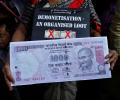
In a big win for the Narendra Modi government, the Supreme Court in a 4:1 majority verdict on Monday gave its stamp of approval to the Centre's 2016 decision to demonetise the Rs 1,000 and Rs 500 denomination currency notes, saying the decision-making process was neither flawed nor hasty.

The theory that all banned notes will come back into the system may not be true. Anup Roy finds out.

The jury is still out on the decision to demonetise high value currency notes on November 8, 2016, with the government claiming it has helped greater formalisation of the economy while critics saying it has failed to curb black money and reduce dependence on cash. On November 8, six years ago, Prime Minister Narendra Modi had announced the demonetisation of old Rs 1,000 and Rs 500 banknotes and one of the key objectives of the unprecedented decision was to promote digital payments and curb black money, besides eliminating terror funding. As per a Reserve Bank data, currency with the public has jumped to a new high of Rs 30.88 lakh crore an October 21, indicating that cash usage is still substantial even six years after the demonetisation move.

Despite the demonetisation of 2016 and the rise in digital transactions that followed, the economy's dependence on cash has remained as high as ever. So when the Reserve Bank of India (RBI) introduced a pilot project of its version of digital cash - called the central bank digital currency (CBDC) - on December 1, many questions were asked. Can the CBDC replace physical cash, even partially? Can it match cash in terms of convenience? Are CBDC transactions truly anonymous?

Could the gains in terms of widening the tax net, increased digital transactions and detection of higher fake currency notes have been achieved without the huge disruption and output loss that demonetisation caused to the Indian economy, asks A K Bhattacharya.

In a landmark judgment that delivered a big blow to the government, the Supreme Court on Thursday annulled the electoral bonds scheme, saying it violates the constitutional right to freedom of speech and expression as well as the right to information.

India's inclusion in JP Morgan's bond index can channel billions of dollars into India. How will the government securities market handle it?
A minimum of 50 per cent tax may be levied on unexplained bank deposits made using the banned currency notes up to December 30 along with a 4-year lock in period for half of the remaining amount under the amendments to tax law the government plans to bring in Parliament shortly.

The government could carry out the demonetisation exercise over periodic intervals along with its surprise element, says Soumya Kanti Ghosh.

With banks struggling to cope with rush to get alternative currency, the government has extended use of old defunct Rs 500 and Rs 1,000 notes for paying household utility bills, fuel, taxes and fees and purchases from co-operative stores till November 24.

The RBI was not party to the decision to demonetize 500 and 1,000-rupee notes, which was taken at the highest level of India's political leadership.

The 30-share Sensex ended down 159 points at 27,425 and the 50-share Nifty closed down 24 points at 8,299.

Changes in lifestyle due to aspects like lockdowns and work from home has created additional demand for items such as television sets, laptops, Wi-Fi routers and even vacuum cleaners, which the bank is funding at present.

Adani Group is expected to report a 20 per cent rise in its earnings before interest, tax, depreciation, and amortisation (Ebitda) at Rs 61,200 crore for the year that ended in March 2023 (2022-23, or FY23), according to a note submitted by the group to lenders recently. The group had earned Ebitda of Rs 57,299 crore in the preceding financial year that ended in March 2022 (2021-22). The group's gross debt was Rs 2.27 trillion as of March 31, 2023, and has projected to not take on additional debt until it lowers its existing one.

'The common man in India who doesn't have anything to hide will have to put up with this short period of discomfort.' 'It will not last more than 10 days at the most.'

India lost fastest growing major economy tag to China in the March quarter with a GDP growth of 6.1%
Congress leader Rahul Gandhi alleged that Modi's move was aimed at helping a few of his 'crony capitalist friends' and had 'destroyed' the Indian economy, prompting a strong response from the BJP which said the exercise was an 'attack' on corruption and black money that were rampant during the 'lost decade' of the Congress-led United Progressive Alliance government.

Piloting the Specified Bank Notes (Cessation of Liabilities) Bill, Finance Minister Arun Jaitley said it will extinguish the government's liability towards scrapped notes and also eliminate the possibility of their bring used as parallel currency.

Some believe the shift to mobile-based transactions will be seamless considering that the urban tele-density is 148%. In rural areas, it is touching 51%. But smartphone penetration in India is a mere 12%. Growth of mobile money has been extremely slow: It is currently 1%.

'In the coming months, expect more government action that will be packaged as an assault on black money,' warns A K Bhattacharya.

I kept insisting that Rs 100 notes were in short supply and there was an urgent need to augment the supply of 100 rupee notes while also rapidly bringing into circulation the proposed new Rs 500 notes. But this was easier said than done because all the note printing machines of the RBI were programmed for printing Rs 2,000 notes and required at least three weeks before the machines could print the new Rs 500 currency notes. The availability of currency paper posed another major bottleneck, and it had to be imported. It was decided to immediately start printing the Rs 500 notes. It was only when the supply of the new Rs 500 notes started improving and the process of change of cassettes at the ATMs gathered momentum that the situation began limping back to normal. A fascinating excerpt from former SBI chairman Rajnish Kumar's The Custodian of Trust: A Banker's Memoir, five years after demonetisation, November 8.

The ripples from November 8 may be seen in next year's state budgets.

Justice Nazeer, along with then Chief Justice of India J S Khehar, was in minority in the 'triple talaq' judgement which was delivered in August 2017.

Junking of old Rs 500 and Rs 1000 notes, he said, will help the world's fastest growing major economy to move towards less cash economy and digital payments that will help shore up tax revenues and check evasions.

India's largest private sector lender ICICI Bank has hit the Chinese debt market for a benchmark issue of about $500 million.

The market last tumbled 10% or more in December 2016 following demonetisation. The decline was followed by a sharp rebound. This time the chances of such a v-shaped recovery are less.

In an online chat with readers, Investment Advisor Harsh Roongta answered their queries on the ban on Rs 500 and Rs 1000 notes.

An expected withdrawal of FIIs from the market likely to weaken the rupee against the dollar.

'The experience so far is a shocking example of how critical scheme of national importance can be brought into disrepute by inefficient and badly designed implementation,' says Dr Madhav Godbole, the former Union home secretary.

Consumer goods, durables, automobiles worst hit.

'The Insolvency and Bankruptcy Code is neither beneficial to banks nor helpful for the borrower.' 'Genuine people who are caught in economic stagnation will lose everything and thousands will lose jobs.'
 © 2026 Rediff.com - Advertise with us - Disclaimer - Privacy Policy - Sitemap - Feedback - About us - Terms of use - Grievances